GLP-1 Access by State · FormBlends network
Find out how GLP-1 prescribing, licensing and coverage work in your state.
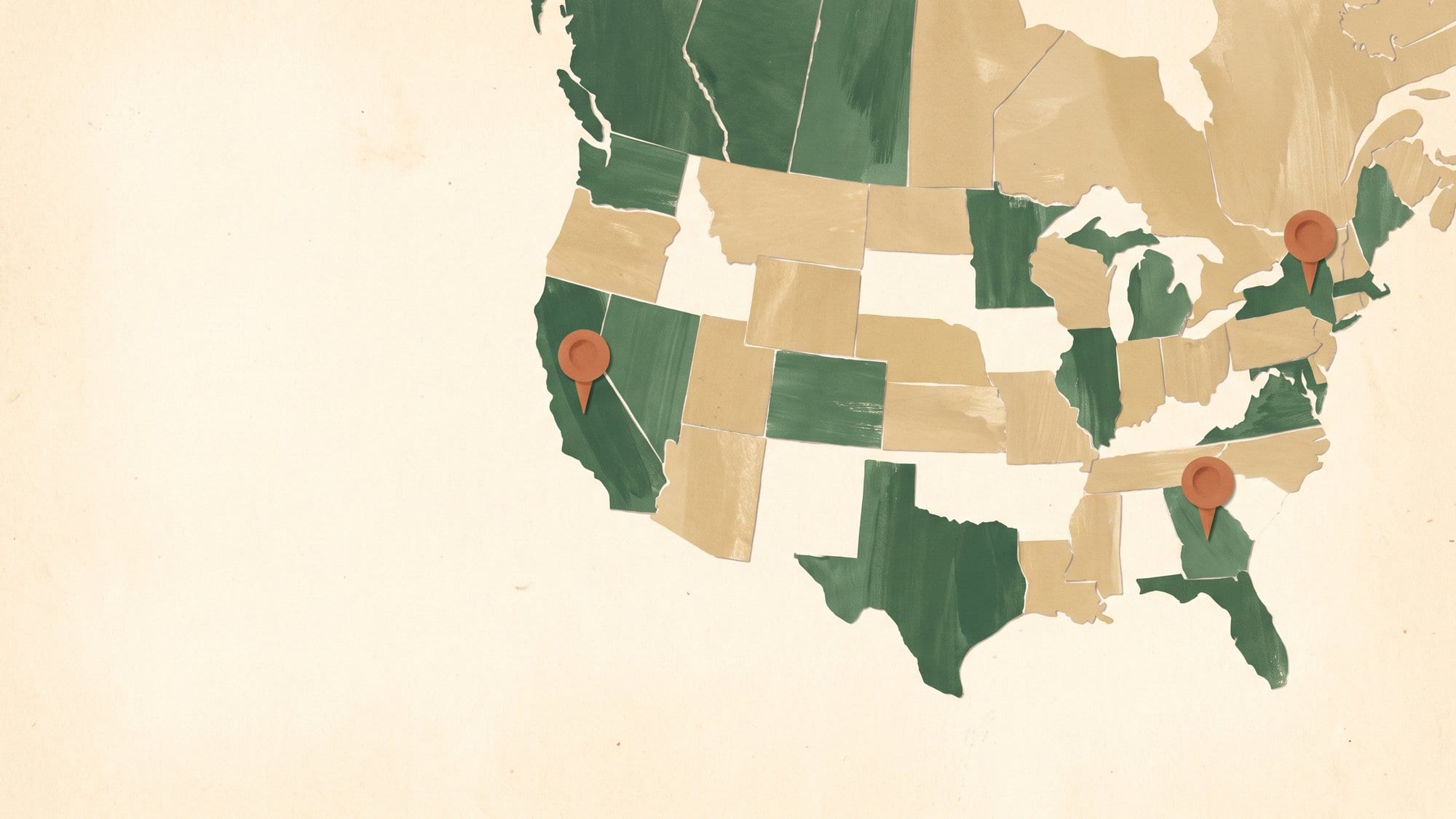
Fifty-one pages, one per state and DC: how to check a prescriber's licence, the telehealth rules, Medicaid coverage for obesity, and where the state board of pharmacy lives.
- 13 states
- cover GLP-1s for obesity under fee-for-service Medicaid
- Medicaid programs that cover GLP-1s for obesity today. Most still do not.
- Same standard
- telehealth prescribing is held to the in-person standard, and the licence follows the patient
- A telehealth prescriber must meet the same standard as an in-person one, in your state.
- 119
- FDA-registered 503B outsourcing facilities nationwide
- FDA-registered 503B facilities you can look up by name.
Start here
Three ways in, depending on what you need right now
- 01State lookupPick a state, see its licence lookups, compact status, telehealth rule and Medicaid position, and copy the links.
- 02How to check a prescriber licence in any stateGet the prescriber's full name, then search the board for the state you were in during the visit, not the company's state.
- 03Browse explainers6 pages, most recently updated September 4, 2026
Interactive
The calculator
Each runs in your browser, shows its formula, and prints a dated assumptions note. Nothing you type leaves the page.

Reading
Start with these
Each page opens with a plain-English summary, a figure drawn from the data, the numbers that matter, and what it means if you're considering treatment.
Explainers
How to check a prescriber licence in any state
You'll get: Get the prescriber's full name, then search the board for the state you were in during the visit, not the company's state.
The three searches that verify the person who signed a GLP-1 prescription: the state medical or nursing board lookup, the federal NPI Registry, and the disciplinary record. What each result means and what it does not.

Explainers
How telehealth prescribing works across state lines
You'll get: The state you are in during the visit sets the rules, not where the company or prescriber is based.
The patient's location sets the rules. What that means for licensure, the in-person exam question, out-of-state telehealth registrations, and why GLP-1s are simpler than controlled drugs. With the pattern our state cards follow.
Explainers
The Interstate Medical Licensure Compact, explained
You'll get: The compact is a faster route for doctors to get full licences in other member states. It is not one multistate licence.
What the IMLC is (an expedited path to full licences, not a multistate licence), which 44 states and DC participate as of the Commission's July 31, 2026 snapshot, which six do not, and what a compact licence means when you look a prescriber up.
Explainers
Medicaid and obesity drugs: why coverage varies by state and changes with budgets
You'll get: Federal law lets states leave weight-loss drugs out of Medicaid, so coverage for obesity varies by state and budget.
The federal exclusion that lets states leave out weight-loss drugs, the 13 state programs KFF counted as covering GLP-1s for obesity in January 2026, the states that added or ended coverage in 2025 and 2026, and how to find out what your own program does today.
Live updates
What changed since this site was written
Sources checked October 21, 2026, refreshed every six hours.
Newest on PubMed
Papers indexed in the last year matching access, coverage and policy (43 in total).
- Delays in access to generic semaglutide point to key missing pieces in Canada's drug approval system
Health Policy · December 1, 2026 · PubMed 42815318
- Real-World Treatment Patterns and Weight Outcomes Before and After a Tirzepatide Price Increase in Over One Million Self-Paying UK Adults With Overweight or Obesity
Diabetes Obes Metab · October 14, 2026 · PubMed 42875827
- Medicaid's GLP-1 Coverage Gap: A Familiar and Correctable Policy Failure
Med Care · October 6, 2026 · PubMed 42837145
- Real-World Adherence Patterns and Predictors of GLP-1 Receptor Agonist Use for Obesity Management in a Medicaid Population
Adv Ther · October 5, 2026 · PubMed 42831955
- Equitable Access to GLP-1 Receptor Agonists-Essential but Not Accessible
JAMA · October 1, 2026 · PubMed 42821279
FDA and enforcement tracker
FormBlends research feed, data as of September 4, 2026.
September 1, 2026 · Adverse-event report update
FDA GLP-1 concerns page updated: 990 adverse-event reports for compounded semaglutide and >730 for compounded tirzepatide (as of May 31, 2026); border screening and fake-pharmacy labelsAugust 28, 2026 · Label or price event
FDA approves Mounjaro (tirzepatide) to reduce MACE risk in adults with type 2 diabetes (SURPASS-CVOT)August 27, 2026 · Court decision
Fifth Circuit affirms summary judgment for FDA in both GLP-1 shortage cases (Nos. 25-10600 tirzepatide; 25-10758 semaglutide)August 24, 2026 · FDA warning letter
FDA warning letters to five peptide vendors: Peak Performance Peptides (735127), Royal Peptides (734884), NuScience Peptides (733652), Peptide Partners (735063), TXP Innovations dba Tex Peptides (735067)August 24, 2026 · FDA warning letter
FDA warning letter: TXP Innovations LLC dba Tex Peptides (Unapproved New Drugs/Misbranded)
Compounded price index
Median all-in cash price per 28 days across providers, as of September 3, 2026.
- semaglutide, month 1 at 0.25 mg/week
- $197
- median of 14 providers
- semaglutide, month 4 at 1 mg/week
- $199
- median of 13 providers
- tirzepatide, month 1 at 2.5 mg/week
- $268
- median of 14 providers
- tirzepatide, month 4 at 5 mg/week
- $299
- median of 12 providers
- September 3, 2026: Index, All, baseline 51 rows. First weekly snapshot. Changes against this baseline will be listed here with the date they were observed.
PubMed lists come from NCBI E-utilities and are not reviewed by us before they appear. Feeds are FormBlends Research data (CC BY 4.0); FormBlends sells compounded GLP-1 drugs and appears in the price index under the same rules as every other provider. Compounded drugs are not FDA approved.
Browse
Sections
57 pages across 2 sections, each sourced to a label, a trial or a dated manufacturer page.
Explainers
You'll get: 6 sourced pages, each with a plain-English opener
The three searches that verify the person who signed a GLP-1 prescription: the state medical or nursing...
States
You'll get: 51 sourced pages, each with a plain-English opener
Alabama in one card: where to check a prescriber and a pharmacy licence, compact member, telehealth...
Why the state matters more than the website
A telehealth prescription is governed by the state where you are sitting during the visit, not the state where the company is registered. That state's medical board licenses the prescriber, its board of pharmacy licenses the pharmacy that ships to you (including out-of-state pharmacies), and its Medicaid program decides whether an anti-obesity drug is covered. Each state page puts those four facts and their sources on one card.
What we verify, and what we refuse to guess
Licence-lookup links were requested on the date shown and marked browser-only when a board blocks automated visits. Compact membership comes from the Commission's own map. Telehealth rules are quoted from the statute or board rule we read; where we have not read one, the page says check with the board. Medicaid status comes from KFF's January 2026 state map, replaced by a state agency notice where one exists. Compounded GLP-1s are described as what they are: not FDA approved.